The post Conan, Comics, Dungeons, and Dragons: An Interview with Jim Zub appeared first on G33K-HQ.
]]>
Comic book writer Jim Zub is no stranger to the fantasy genre. D&D fans have him to thank for Minsc and Boo making their return to the Forgotten Realms in the Dungeons & Dragons: Baldur’s Gate comics, his creator-owned Skullkickers comic is getting reprinted in new compact editions, and he’s currently writing Conan the Barbarian for Titan Comics.
And it just so happens that we here at G33k-HQ are pretty big fantasy fans ourselves.
So we were delighted when Jim agreed to sit down for us with an interview, where we discussed his run on Conan, his experience with tabletop roleplaying games, what he’s got planned next, and who would win if his characters fought. You can watch the video below, or read it all here:

G33k-HQ: Jim Zub, thank you so much for being here.
Jim Zub: No problem, thank you for having me.
G33k-HQ: So you are basically the go-to sword and sorcery guy in comics right now. You’ve written D&D comics, including two different Rick and Morty versus Dungeons & Dragons. You’ve done Conan the Barbarian for Marvel and Titan. You’ve even worked in a fantasy world storyline for Champions. So my first question is: what eldritch being must I make a contract with to get a fraction of that?
Zub: It’s really special, I’ll tell you that. I wish I could tell you I had a grand plan and knew exactly where all this was gonna go when I started off in my career but, honestly, I’m as amazed as you when I think about how it’s all turned out in terms of the projects and properties I’ve been able to contribute to.
Arguably, Dungeons & Dragons and Conan the Barbarian are two of the biggest fantasy properties anywhere, and I’ve had multiple times where I was writing on both of them at the same time. My first big creator-owned series was Skullkickers, which was also sword and sorcery – more swords and sassery, really, when you get right down to it. It was a comedy series. I’ve worked on Pathfinder, Samurai Jack, all kinds of amazing stuff.
If someone’s swinging a sword, I’m interested; monsters and supernatural and sword and sorcery are definitely my jam.
It’s really incredible. I wish I could sum it up more poetically than that, but almost every day I have to pinch myself when I realize what I’m working on.
G33k-HQ: Right now you’re working on Conan the Barbarian for Titan. How did you get that opportunity?
Zub: Well, I’ve done multiple Conan projects over the years. My very first Conan writing project was co-writing with Gail Simone on the Conan/Red Sonja crossover series that Dark Horse and Dynamite did back in 2015, and that was a ton of fun. We had a great time working on it, and I thought that would be my only chance to ever write Conan, so I put my all into it.

Gail brought me on board for that very special project, but then, three years later, Marvel got the rights to Conan back and Jason Aaron was the flagship writer at that time. I was still really excited about the character, and I got to write him as part of an Avengers event called “No Road Home” where we brought him in and mixed him up with Earth’s Mightiest Heroes.
But, in both those cases, the Conan/Red Sonja miniseries and Avengers: No Road Home, it was co-writing; I was working with Gail or I was working with Mark Waid and Al Ewing. So even though I was writing the majority of the Conan stuff, selfishly, I wanted my own solo Conan credit. So when Marvel brought back Savage Sword of Conan as a full color anthology series, I pitched the editor there a few self-contained Conan stories.
Thankfully, one of the stories I pitched was called “The Gambler.” That was the one they approved. Patch Zircher drew the living hell out of it, and it got on the radar of the rights holders for Conan the Barbarian.
They really liked that story; they felt like it hewed pretty close to the original Robert E. Howard style material. You know, the character has been around since the 30s, and that pulp sensibility can kind of wax and wane depending on who’s writing the character, but that was something they very much wanted to reprioritize.
So when it came time for Jason to eventually leave the book, I was suddenly in contention. Once again, I thought it would be my last chance to write Conan, and instead it became an audition to do more with the character. I ended up writing the monthly series at Marvel for, because of lockdowns and the pandemic, about a year and a half.
And then, the rights lapsed and they took them back. I had stayed in touch with the rights holders ever since. They were looking at doing something different in terms of their comic publishing strategy, and they wanted to give the character a bit of a break. So for about a year, they wanted to let things go quiet, reorganize and replan.
The publishing plan they put together with Titan was kind of unique. A lot of times, when you see these intellectual properties being published in comics, that’s a licensing deal. All the artwork and the stories are being generated by the publisher and they have to get approved by the IP holders.
In this case, the IP holders, Heroic Signatures, wanted to have a more direct hand in the creative development of the comics. That was really important to their core publishing plan going forward.
I was one of several writers they asked to pitch on relaunching the series in 2023 with Titan, but all that creative stuff would be done in-house. So, unbelievably, I was able to pitch on the series and kept the diamond. I was able to keep working away on it, and we did our new Conan relaunch in 2023, and it has gone incredibly well.
We’ve got just the best damn sword and sorcery artists in the business working on it. The momentum from readers and fans has been incredible, and I just feel so incredibly fortunate because so few people get to write these kinds of iconic characters, let alone do it multiple times, let alone have the latest one be a hit after you’ve done it before.
It’s just a crazy confluence of events I never could have ever planned for.
G33k-HQ: I’ve noticed that when you were writing Conan for Marvel or Titan there are definitely some differences in the themes, atmosphere, and level of mature content. What would you say are the biggest differences when writing him for the two different companies?
Zub: Writing it at Marvel, I was very much trying to hew to the old Marvel continuity. Also I was aware that it was a PG-rated book we were putting together for the market. You know, the standards and practices that Marvel has as part of their publishing line.
I got the opportunity to do the series, but it was something where I didn’t know how much space I would have to tell those stories. I was trying to make them relatively self-contained, but seed potential future stories where I could, never really knowing how long I was going to have to work on it.

The big difference now, working at Titan, is first of all, we have a mature readers book, so obviously I can do a lot more intense content, more like the original pulp stories from the 1930’s.
I also have a much bigger runway. I’m signed on a long-term deal to do 50 issues of the flagship series, plus an event mini-series every year, and some extra stories for Savage Sword, the anthology series we brought back as a black-and-white magazine. So I’ve got a much, much bigger tapestry to weave.
I know where the story is going over the course of this four-and-a-half, five-year plan and I can foreshadow and then pay that stuff off in ways that just wasn’t possible under the limited scope of what I was doing at Marvel.
Everyone I worked with at Marvel was amazing. My editor, Mark Basso, and Roge Antonio, and Cory Smith, and everyone on the team was amazing. It was just a different priority when I was working away on it. It was a licensed title where we didn’t know how much space we had.
Now we’re the flagship book for Heroic Signatures and the biggest book at Titan, so having that regularity and knowing we can plan out long-term has just given me a lot more levers I can pull.
G33k-HQ: This does bring me to my next question, because there’s a lot of history to Conan; a lot of continuity from the novels and previous comics.
Zub: Conan’s older than Superman, so there really is. He’s a literary icon, and I’m very much aware of that.
G33k-HQ: So how do you balance the long continuity while keeping new readers engaged, bringing them in and not having them go: “who’s that?”
Zub: I think the most important thing is, like any iconic character, whether you look at, Batman or Superman or Spider-Man or Wonder Woman or any of those, although you have hundreds of stories of those characters, there are core, inalienable things you need to understand and hue to, to make sure the character feels right and sounds right.
Conan has an overall timeline. He starts off as the young impetuous thief who has wanderlust and leaves his home country to see the world, and becomes more and more integrated into civilization even though he’s the barbarian. He goes from being a thief and a reaver to a mercenary, eventually a leader of men, and then further still the king. So we know that overall journey.
Then it’s a matter of putting a flag in the ground for each particular story. Where are we at in that evolution? Who is he as a character, and what is there we can still glean from this particular part of his life?
It’s just like any other icon. You don’t read a Batman story and go, “Man, I wonder if Batman’s gonna win.” You’re like, “Well, that’s his name on the front cover. He’s gonna win.”, so I have to try and set up situations that are surprising and shocking and keep you guessing in terms of how we’re going to get to that conclusion in and around the genre material that makes sword and sorcery so awesome, and the very particular darker, more grounded, fantasy world that Robert E. Howard put together.
This is not a place with elves and dragons and orcs or things like that; it’s very much a world of men, where the majority of conflict is between tribes and kingdoms. There are monsters and there is magic, but it’s much more mysterious. It’s much more cursed, and it’s a much darker, more secretive place.
It’s really using as many of those ingredients and trying to stick with the pieces that make the Hyborian Age feel the way it’s supposed to. The longer I do it, the more I get into that flow of knowing, “yeah, this feels like the right kind of direction,” particularly when it comes to the narration.

One of the things that makes Robert E. Howard’s writing so special, and why it has stood the test of time, is because it has a very lyrical poetic quality to it. It’s not just about characters kicking ass. It’s very much about the atmosphere he’s able to summon up in his words, the way he describes places and times and magic and creatures.
There’s something very potent in the way he wordsmiths, and it’s one of the reasons why the original comics stood out so much, because Roy Thomas tried to use that same kind of language when he was doing the captions and narration in the comics.
Some of the best writers who have ever done it – Kurt Busiek, or Tim Truman, or any of the writers over the years that did it right – they had that poetic quality in their narration as well. So one of the things I really had to learn (and I feel like I got a pretty good handle on it at Marvel, but then I marinated in it even more so with the new Titan series) is getting that feel for the language; the particular vocabulary, the way to structure those sentences, the way characters talk, and the way to describe that world.
It’ll never sound modern, and it’s not meant to. It has to evoke that particular language and atmosphere that made the original stories stand the test of time.
G33k-HQ: On a similar note, are there any rules or guidelines you’ve set for yourself when writing Conan the Barbarian? I know that we just talked about how the atmosphere and the kind of epic poem style has to be the same. Is there any sort of “Ten Commandments of Conan” that you follow?
Zub: I don’t know about a “Ten Commandments,” but I’ve certainly got things I’m keeping in mind. The best of the original Robert E. Howard stories, at their core, are usually playing with this overarching idea of “civilization versus savagery.”
This concept that: although the civilized man has been able to build all these cities and create incredible kingdoms and governments, there is a duplicity at the heart of it. Whether it’s government or religion, the leaders of these worlds have become powerful by using others, by being dishonorable, by stabbing others in the back, or by building their power on the backs of the weak.

And although Conan is a barbarian, he’s violent and dangerous, he’s also honor bound in the sense that if he tells you he’ll defend you or he’ll stand by your side, he’ll do so till his dying breath.
So, in a world like that, of survival and dark power, who is truly civilized and who is truly savage? That tension drives a lot of what makes a great Conan story work. It’s not just “Conan kills a monster,” “Conan saves some beautiful woman,” or “Conan interacts with dark magic.”
It’s that underlying tension between the barbaric side of himself and the human side of himself, or how he interacts with that civilized world and his frustrations around freedom versus law, or things that are happening outside even his knowledge – the greater wheels of machinations of gods and demons, and things like that. He is the ultimate “fly in the ointment” with his ability to survive, his ability to thrive despite their best efforts.
So when I play with those things, I find I’m going down the right path for a Conan story. I’m putting him up against incredible odds, but there’s even more fuel in the engine when I use that stuff instead of just the veneer and the trappings of, “okay, he’s got a sword. All right, he’s going to fight a bad guy.”
There were dozens and dozens of fantasy heroes through the 30s, 40s, 50s, 60s and 70s. In the fantasy genre, there are hundreds of characters that have fallen away, but he sticks around. The reason why Conan sticks around is because there’s more there than just the surface level of that icon.
G33k-HQ: Any hints you can give us about what’s next for Conan?
Zub: Sure. On Free Comic Book Day, we have the prelude for our next big event. It’s called “Tides of the Tyrant-King,” with the return of Thulsa Doom, the Atlantean necromancer who has haunted Conan through the ages.

It’s going to be massive. Jesus Merino is drawing the miniseries, and it’s an epic tale in the same way we did with “Battle of the Black Stone” and “Scourge of the Serpent.”
We really put a button on each year with the theme of that year, and pay off a lot of the parts we’ve been building in the main monthly series. We get to play with other characters Robert E. Howard generated, beyond just Conan, and weave them together into this grand epic story that is increasing in intensity and building momentum towards a big finish I have for the series. This is year three of the plan, and it’s full steam ahead.
Working with artists like Jesus is just an absolute honor. He’s phenomenal. The same thing is true with our monthly artists as well. You know, you look at Doug Braithwaite or Fernando Dagnino, Roberto de la Torre – these guys grew up on Conan and it’s just blood pumping through their drawing fingers you see on every single page. I think all of us bringing that passion to the series is what makes it so special.
G33k-HQ: We’ll shift away from Conan for just a bit, because you’ve also written for Pathfinder and Dungeons & Dragons. Can you tell us a little about that journey, both your experience with the games and getting to write the comics?
Zub: Totally. I say it all the time, but it never grows old: I would not be a writer without a tabletop role-playing game, specifically Dungeons & Dragons.

I grew up on the game, and it ignited a desire to not just passively read or watch stories, but to make them, to generate them, and bring them to an audience. Being at the gaming table with my older brother and cousins changed the way I thought about storytelling, changed the way I thought about teamwork, and interaction, and building things.
It’s essentially a creative fire that has never died. And so, when I’m working on a comic project, or any other kind of creative writing project, I’m always mentally framing it in the terms of a tabletop role-playing game; I’m the Dungeon Master, or I’m a player and a participant.
I’m trying to both entertain and communicate, and make this the best journey I can every time I get to work with someone. Or, if I’m writing a particular character, for lack of a better term, I’m role-playing through that character. It’s not about me trying to impose my voice on them. It’s trying to find out who they are, what their personality is, how they speak, what their goals are, and things like that.
So because tabletop gaming is so intrinsic to my creative career, getting to work on this stuff officially, getting to do stories that are canon within Pathfinder or Dungeons & Dragons, it’s mind-bending in the best way possible. It’s an absolute honor and a joy to be able to contribute to this stuff, to be a small part of the legacy of these games, and to kind of bring it all full circle for me as a creator.
G33k-HQ: Speaking of the canon, a lot of the elements from your comics have impacted the lore and characters in both those games. I believe it was you that made Kyra and Merisiel in the Pathfinder comics a couple. I’ve seen Delina appear in the D&D Player’s Handbook and the Dungeon Masters Guide. So what was that like? Was any of that planned, or were you just as surprised as we were to see all that happen?
Zub: I mean, every time you work on something where you contribute to an existing property, you hope that it will last. You hope that you will have a meaningful effect upon it. And so I can’t say I didn’t plan it, but obviously you never know whether or not stuff is going to stick.

Having characters that are now part of D&D canon is mind-bending. Like Krydle, who’s the thief character I came up with for the Baldur’s Gate comics we released through IDW – he’s now a Magic card, and he’s an example character in the Player’s Handbook. Delina the wild mage is a Magic card, and quite a powerful one people will build their deck strategies around.
G33k-HQ: I’ll be honest, I have decks that use both of them.

Zub: She’s the one who brought Minsc back from being turned into a statue so he could be part of the modern Forgotten Realms, instead of how many of the mortal characters who have passed away because the timeline has advanced so much.
So having that exist in broader D&D – the fact that because she did that in the comics, Minsc is in the modern Forgotten Realms so he can be in Baldur’s Gate 3 – it’s surreal in the best way possible.
It’s a joy. It’s the kind of thing you would tell your friends when you’re a kid: “Oh yeah, my characters will be official D&D characters someday,” and you’d laugh it off, but here we are. I’m living my best 10-year-old kid life that I possibly could, and I think that’s all any of us can hope for.
G33k-HQ: Honestly, when I was playing Baldur’s Gate 2, I did kind of get Krydle’s dad [Coran] killed and went “Whoops… well, that messed up the timeline a little.”
Zub: No, it’s good. I love that these games and the permutations of them echo out ever further. I love that people interact with this stuff. And the whole point of role-playing games is that you’re generating your own stories anyways. That’s what’s so great about it.
It’s not about my version of Curse of Strahd, or The Temple of Elemental Evil, or White Plume Mountain. It’s about yours at the gaming table and if we make stuff that generates excitement and inspires you, great! But in the end, your game is your own.
G33k-HQ: So what would you say the biggest differences are when writing for these different fantasy series – Conan, D&D, Pathfinder, Skullkickers? Because all of them do have very different atmospheres to them.
Zub: They do. You know, they’re all different permutations of sword and sorcery and fantasy. Obviously, Skullkickers is the most irreverent; It’s sort of “Deadpool meets D&D.” It’s me, as an eight-year-old boy, kicking down doors and causing chaos at the gaming table as much as humanly possible.

Both Pathfinder and Dungeons & Dragons are high magic fantasy worlds filled with all kinds of magic systems and races and creatures all over the place. There’s examples of fantasy almost everywhere you go. So using those spells and magic items is pretty intrinsic to how we tell the stories, and getting those details right in terms of the setting material and things like that.
With Skullkickers, obviously, I’m making it up myself. The only person I have to please is myself in terms of keeping any kind of canon. Whereas with Pathfinder or D&D, these are established worlds – the Forgotten Realms or Golarion – where you want to hit the mark in terms of how they’ve been described or depicted in those books.
Conan is the darker, more poetic version of those things. It’s very serious; it’s not going to be humorous very often. Although Conan is described as a character of “both great melancholy and great mirth,” there isn’t a heck of a lot of mirth in those stories. It’s quite an intense and violent world full of survival, and it’s one of the pillars of inspiration that led to D&D.
You can see that in stories like “Tower of the Elephant,” which is a classic thief’s story – enter a dungeon and try to steal the treasure – but it also has its own specific kind of milieu.
The permutations that they have of sword and sorcery make it feel so grounded and mysterious, because you’re seeing so much of it through Conan’s eyes and, as a warrior, he doesn’t understand the rituals, the spells and magic items. They’re not as prevalent and relevant to his stories, in the sense that he uses them on a constant basis. They’re cursed items or secret things momentarily igniting parts of the story. So in that way, although there are horrific monsters and demons, at its core, Conan is lower magic in how it deals with that world.
I’m tuning in the dials. They’re all sword and sorcery, but depending on which project I’m working on, I’m tuning certain frequencies up or lowering other ones down, getting into that mode. And if I need to, going back to the source material and reminding myself what makes this particular one tick so I get it right, because it means a lot to me as both a fan and a reader.
G33k-HQ: I’m just kind of seeing a graph with the X and Y axis being serious-to-humorous, and then high-fantasy-to-low-fantasy, with each of them falling on a different place on there.
Zub: Totally, and that’s what’s so fun about it. It’s funny; people will say to me, “You must be worried about burning out or running out of ideas.” But no one ever says that to the superhero guys. They’re never like, “Are you sick of writing Spider-Man?” to Dan Slott.
No, this is my favorite thing! I absolutely love writing sword and sorcery. I love the supernatural. I love monster stories and I’ve got a near infinite well I will be constantly going back to, because this is the stuff I grew up on.
G33k-HQ: I could talk about fantasy and tabletop games all day, but there are other comics to discuss as well, because you recently contributed to DC’s “MAD About DC” comic; you have Guy Gardner vs. Spy vs. Spy. What can you tell us about that project?
Zub: I mean, it was such a joy. I think so many of us grew up on MAD Magazine, and it was just a delightful, bizarre, irreverent part of our monthly reading. You know, the world felt like this overwhelming place and MAD would always be there to ground it in humor and poke holes in the people who thought they were too good for themselves or knew it all.
I grew up reading that stuff. I absolutely love the Don Martin cartoons, I love Spy vs Spy, just all of it. Sergio Aragones and all that really made an impression on me. A lot of the humor you see in things like Skullkickers are a byproduct of stuff like MAD.

So when Chip approached me and said: “Hey, we’re putting together this special issue – pitch me,” I was blown away at even the possibility I’d get to contribute to it. I told him I wanted to do Spy vs. Spy. That was number one for me and he said, “oh man, that’s going to be competitive. Just make sure you’ve got other ideas because that’s going to be one of the ones that’s going to be really hard to grab a hold of.”
And lo and behold, Ramon Perez and I were able to eke it out. We got it for ourselves.
Getting to do Guy Gardner and the interplay and the contrast between them – Guy’s obviously all mouth and big talk and the Spy vs. Spy characters never talk to each other, the black spy and the white spy. They have no dialogue, so the interplay of that was a lot of fun.
Getting to play with the Green Lantern lore elements, trying to pack it all into a two-page crazy comic and put in the kinds of gags, the ridiculous little inventions and moronic violence in there as well was really special.
Ramon even went one step further; he has our names in the morse code, which is exactly how they used to do it back in the classic strips. Fun things like that to try and honor what came before.
G33k-HQ: And I believe you’re also working on Manga Classics: Journey to the West; the prelude is coming out on Free Comic Book Day. What can you tell us about that?
Zub: I was part of the Udon studio for many years, and I love those guys over at Udon. They do all sorts of amazing stuff. I’ve written Street Fighter comics and contributed to a bunch of their projects when I was at the studio.
They have a line of books called Manga Classics, where they take classic literature and make manga versions of them. They’ve done incredibly well over the years; they’ve got everything from Pride and Prejudice, to Les Miserable, to Shakespeare – all kinds of different things.

And Journey to the West is obviously ambitious and they wanted to take a real adventurous, almost One Piece action-packed approach to it, like a shonen manga. Erik [the head of Udon Entertainment] showed it to me and he said the one thing he really wanted to do was to amp it up in terms of epic narration. He wanted it to be fun and frantic, but also literary in a way, using some of those philosophical concepts from the original source material.
And so he says: “Between Skullkickers and Conan, I feel like you’ve got the narrative air, but you also understand manga and the interplay and silliness of it. And I’d love for you to do the writing on this.”
We’ve actually got the story structured out, but almost like when I do plot script on Conan with the existing art there, I’m adding to it with narration rather than doing full script. So it was more like that. The script and main story were already built, and then I was going in there and adding that narrative component and to try and tune it up as much as I can.
It was a neat challenge, it was a lot of fun, and I hope people thoroughly enjoy it because that line of books is bringing in thousands and thousands of new comic readers to the medium, particularly when you can get them in school libraries, reflecting these classic literary works. So it’s a really cool project.
I already had a Free Comic Book Day lined up with our Conan: Tides of the Tyrant-King, so I thought that was going to be my Free Comic Book Day book. Then Erik let me know that they were releasing the Journey to the West sampler as well, so I’ve got two books coming out the same day. It’s going to be a double-Zubble.
G33k-HQ: And Journey to the West is lengthy. So that’s going to be a long-term project if all goes well.
Zub: Yeah, I’m hoping we’re going to be digging in on even more. For the first one, the response seems to be really strong so I’m excited to build out from there.
G33k-HQ: Now, are there any series that you’d like to try your hand at writing and you haven’t had the chance to yet? What’s on your wish list?
Zub: I mean, I love the supernatural and magic sides of these superhero universes. So getting to do something in that kind of space, whether it would be a Swamp Thing or Constantine over at DC, or Ghost Rider, or Blade, or Doctor Strange at Marvel would be pretty intrinsic to who I am and what I really love. There’s the fantasy and magic elements of it, but imbued into the superhero universe, so either of those would be really sweet to try my hand at.
But most of the other stuff I’ve kind of done. I mean, everyone loves Spider-Man, everyone loves Batman, and Wolverine, and stuff like that. So I’d be foolish not to grab hold of something like that. Given the fact that I’m now associated so strongly with Conan and that kind of badass action-packed character,I would love to bring that same kind of gravitas and intensity to Wolverine.
But, for the most part, I’ve already had the chance to dig in on so many amazing characters. So I’m not pining “Oh my god, my entire career hangs on my need to do any of these other characters.” I’ve got new creator-owned books I’m developing right now that will be announced later this year. I’ve got other cool projects I get to be a part of. I’m pretty creatively fulfilled right now. I cannot complain.
G33k-HQ: So, some secret projects coming up, that kind of goes into my next question: Anything that you can tell us about what you got planned for future projects or is it all hush-hush?
Zub: A lot of it is behind the scenes. I’m contributing to a video game that will probably get announced later this year. I’ve got another commercial comic writing gig that’s going to get announced by the summer. I’ve got a new creator-owned book at Image that will be coming out at the end of this year or early next year.
G33k-HQ: A lot to look forward to, then. Lastly, I’m pretty sure I’m legally obligated to ask: what advice do you have for anyone looking to get into comics?
Zub: The reality is: there are new creators entering the industry all the time.
I know it can feel like an impenetrable monolith when you look at it from the outside, but all your favorite creators, the newest creators who are making waves, they all started the same way: they made their own comics imbued with the kinds of stories that they love to read. They figured out how to work at the same professional kind of quality, so someone would look at them and say: “Man, I would pay you to do that for us.”
You have to make the kinds of stories you’ve always wanted to read. You have to put those out into the world, and you’ve just got to keep doing it and building up your experience, your quality and your connections.

The more you go out into the industry, go to conventions, and reach out to people online, and keep putting out work, the more you will grow. That doesn’t mean you’ll get all the success you hope for, to get to work on every single property you ever imagined, but you will always improve in terms of your skills and the unexpected experiences you get to have.
I’m not working on any of the kinds of things I would have thought. As a kid, I never even imagined I could contribute to D&D, or Conan the Barbarian, or The Avengers, or any of that stuff. But the sensibilities that led me to those things make sense looking in the rearview mirror.
Put together comic book stories, learn about the form. I’ve actually got over 40 free articles on my website detailing how scripts are written, how to pitch a publisher, what it’s like working with an artist and an editor, and a lot of the things I wish I’d known when I was starting out.
So look for things like that, because that’s a free resource at your fingertips. I’ve also got extensive examples on my YouTube channel going through how I wrote a particular sequence or a script, how the artist interpreted it, and then how we take that to the finished published page.
G33k-HQ: Oh, and one last goofy question: Conan, Minsc and Rex get into a bar fight. How does it go?
Zub: Oh, man… Well, it depends on which bar it is. Because if it’s the Gizzard, the all-dimensional bar, then Rex probably has all the advantages there. But otherwise, I do think Minsc and Rex are in deep, deep trouble, because Conan’s the original sword and sorcery hero, and he’s probably going to bring them down.
G33k-HQ: Yeah, that makes sense. And it would obviously take place in the Gizzard, because that is every fantasy bar that’s ever been.
Zub: That’s right.
G33k-HQ: Well, thank you very much for your time, I appreciate it. If our readers want to follow you or your work, where can they find you?
Zub: Everything’s at jimzub.com. I’ve had that website for 26 years and it’s not going anywhere.
We’d like to thank Jim once again for taking the time to speak with us. Keep an eye out for Conan the Barbarian: Tides of the Tyrant-King and Manga Classics: Journey to the West this Free Comic Book Day, and we’ll see you at the Gizzard!
The post Conan, Comics, Dungeons, and Dragons: An Interview with Jim Zub appeared first on G33K-HQ.
]]>The post Comic of the Week: “Dungeons & Dragons: The Fallbacks” #1 appeared first on G33K-HQ.
]]>
“Dungeons & Dragons: The Fallbacks” takes the characters from Jaleigh Johnson’s D&D novels and brings them into the comics. While the characters aren’t new to the Forgotten Realms, the story is still an original, rather than an adaptation of Bound for Ruin or Dealing with Dragons (which are also good novels I’d highly recommend). It also doesn’t require any prior knowledge about the Fallbacks or their previous adventures, as writer Greg Pak introduces them to the readers through both captions and the natural flow of the story.
Right off the bat, we’re given a clear understanding of who these characters are. A quick action sequence shows us each of their skills in action, from Tess’s teleporting daggers to Cazrin’s magic, while showcasing their personalities at the same time.
For instance, when we’re introduced to Tess, we see how she’s kind and generous by offering to give some coins to a kobold beggar… but also that the party is flat broke, which we can later see informs her actions when she chooses to get involved in any matter with a monetary reward. We get to learn more about other characters in a similar way, such as the fighter (Anson) trying to talk down his enemies before attacking, or through the banter the bard (Lark) exchanges with just about everyone.
In other words, the characters are absolutely brimming with personality in everything they do. Each one has a distinct voice that comes through in their dialogue, how they bounce off each other, and the choices they make throughout the story.

Now we get to the story itself. As this is the first issue, it mainly serves as an introduction and setup, but it still has the quintessential D&D elements that fans know and expect. Rival adventuring party? Check. A wide array of species and creatures from the game? Check. A dungeon with monsters and treasure? Check and check. It’s all there, and it fits into the narrative seamlessly, making the story feel like the start of a D&D campaign in the best of ways.
So we’ve got great characters, a strong supporting cast, and the start of a quest that kicks off with plenty of action and the promise of bigger adventures to come. What more could we ask for?
Now let’s talk about the art. Wilton Santos provides the penciling for this issue, with Edvan Alves doing the inking and Raúl Angulo on the colors. The art itself is excellent, with strong character designs, a great sense of panel composition, and the perfect balance of detail that makes the world feel alive.
While the character designs themselves were established on the covers of the Fallbacks novels, Santos captures all their key elements in his own style and fills them with personality. Their expressions, body language, and even their framing in each panel showcase a great deal about who they are and how they’re feeling, even when they’re just standing in the background.

The same goes for the new characters and even the background characters. One look at the rival party and we can tell so much about them immediately, thanks to their designs and body language alone.
Also, there’s an important balance to strike with Uggie the otyugh to make a young garbage-eating monster both adorable and gross at the same time, and Santos nails it.
Each panel is filled with details on both the characters and backgrounds that make Faerun feel alive. The designs on the armor, the architecture of the buildings, and the characters hanging around the background of a tavern all add to the world, so they receive as much care and attention as the heroes. When we get to action scenes, the action is swift and fluid, capturing each key moment in the fight while controlling the pacing.
Santos often connects his panels by having details from one extend beyond the panel’s edge and into the next, or overlapping one with the one connecting to it. This subtle trick helps control the pacing, drawing our eyes from one scene to the next naturally. It’s particularly useful in the fight scenes, as it takes readers on a journey through the action.
All the while, Raúl Angulo’s color work brings each page to vivid life, helping the characters pop off the panel and adding a vibrancy to the world. Angulo’s color work is bright and clean, making it easy on the eyes and a fine match for Santos’s illustrations. Each character has a distinct color theme, like Lark’s white outfit over his red skin or Baldric’s gold coat, but they share enough elements that they feel connected, like a proper party should.
Angulo also knows when to shift the color to change the scene or accentuate action. The natural shades of sky blues and light brown streets give way to the yellow illumination of a tavern, which is replaced in turn by the darker blues and grays of the night sky and road. Sickly green shades let us know when evil undead approach, creating an unnatural atmosphere that controls the mood, and action scenes are occasionally highlighted with bright backgrounds of gold or red to bring out a key moment.
Good color work can do so much to control the atmosphere of the scene and impact of each moment, and Angulo’s colors do just that.

The worlds of Dungeons & Dragons contain limitless possibilities for adventures, characters, and stories for readers to enjoy. We’ve seen this through unforgettable stories like R.A. Salvatore’s Drizzt novels (and their comic book adaptations), Jim Zub’s comics following Minsc and his friends, and now, The Fallbacks. The comic feels like an actual D&D campaign, filled with fun banter, likable characters, and the start of a great adventure, with excellent artwork bringing each moment to life.
If you’re a fan of The Fallbacks novels, rest assured, the characters are in good hands. And whether you’re new to the world of Dungeons & Dragons or a longtime adventurer (or Forever DM) looking for a new story in the Realms, you’ll find it here.
The post Comic of the Week: “Dungeons & Dragons: The Fallbacks” #1 appeared first on G33K-HQ.
]]>The post Comic of the Week: “Imperial” #1 appeared first on G33K-HQ.
]]>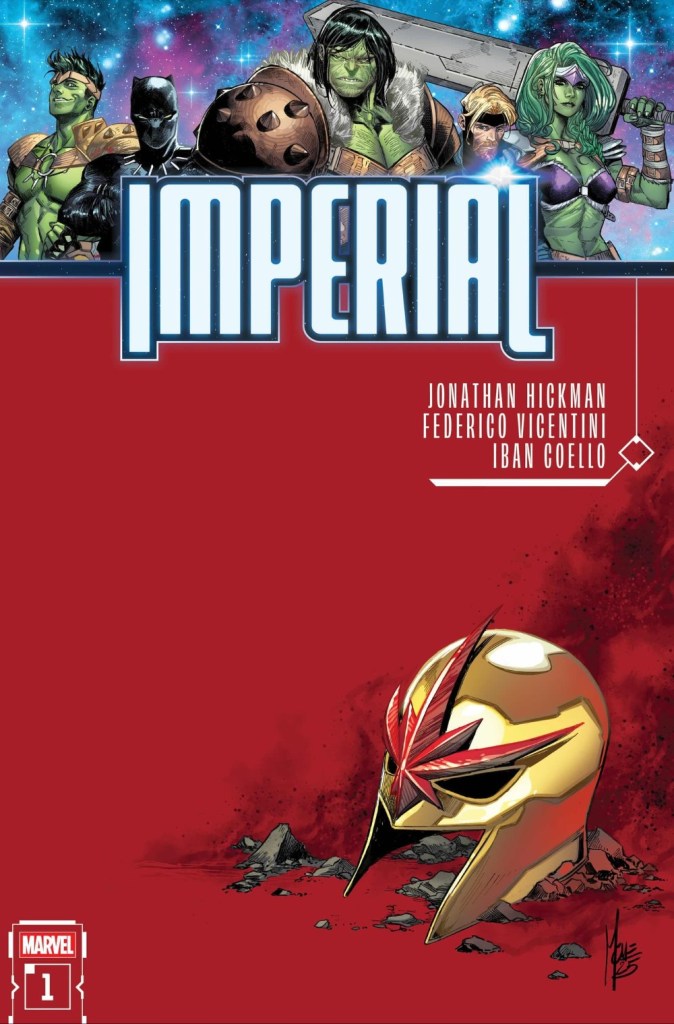
“Imperial” #1 serves as the introduction to the event, but the issue still hits us with multiple events that will have a significant impact on Marvel’s cosmic heroes (and also the Hulks). Like many comics of great importance, we begin with powerful cosmic forces playing a game, the sheer scope and consequences of which we’ll see play out as the event unfolds.
The comic is split into several parts, carrying on the story while moving the focus between a few key characters. While most of them are familiar to anyone who enjoys following spacefaring heroes, like Nova or the Guardians of the Galaxy, we still start with three Hulks (Bruce Banner, Jennifer Walters, and Amadeus Cho), providing a more familiar point of entry for readers who might not be up to date with the latest cosmic events.
Of course, this is tied up in Hulk history and lore, as they travel to Sakaar En Nevo for the funeral of Hulk’s son, Hiro-Kala. If none of those names sound familiar to you, that’s okay — it serves its purpose of bringing the Hulk into events and introducing readers to the ongoing events. From there, writer Jonathan Hickman takes us deep into galactic politics, where we’re shown the greater mystery and conspiracy in progress as well as bringing Star-Lord and Nova into the mix.
This issue takes its time setting the pace and introducing all the plot elements that need to come together while building the mystery and the political tension before upping the stakes and kicking off the first major conflict of “Imperial.” In doing so, it allows us to get reintroduced to the characters and the fragile political state of the cosmos, including key elements like Hulkling’s role as the king of the Kree-Skrull Empire, the spacefaring Wakandans, and Star Lord’s family. There’s a lot to take in, but Hickman introduces them all at a measured pace so readers who might not have learned about, for instance, Hulk’s kids or the Wakanda in space can absorb it all.

“Imperial” #1 boasts two artists: Iban Coello and Federico Vicentini. While the two have noticeably different styles, they each bring their unique strengths to the comic.

Iban Coello’s artwork features detailed designs with strong definitions and clear volume. Each character, whether human, Hulk, or alien, has a unique and consistent silhouette, complete with eye-catching outfits. For instance, the Hulk in his Worldbreaker armor strikes an imposing form, with shading that highlights each of his many muscles and rippling veins, whereas Brawn (Amadeus Cho) strikes a leaner but no less intimidating form, with an equally impressive but distinct armor set.
Other aliens are given impressively inhuman designs that remain expressive and detailed, such as how a nine-eyed alien’s brows furrow as it speaks, or how Hiro-Kala’s former wives each have distinct features they share with their children.
The same praise can be said for the rest of Coello’s art. The backgrounds in Sakaar En Nevo immediately set the tone for the planet, and are overflowing with details and touches that make the world feel alive. Meanwhile, the action pieces are filled with dynamic motion and huge impacts, and the crowd scenes feature a wide array of alien designs.

Federico Vicentini’s style is different, with more rough and jagged character designs that rely on sharp lines. The character designs aren’t quite as distinct (I’ll be honest, the only real difference between Nova and Star-Lord is their hair colors), and the proportions and expressions can feel a bit off.
However, Vicentini is also a master of composition. The way the characters and action are placed in each panel provides excellent visual storytelling, including excellent uses of reflections, framing, and body language.
Vicentini’s panels are also filled with motion and detail, making the crowded set pieces feel all the more active. One of the best panels in the comic is a two-page splash featuring J’Son (King of Spartax and Star Lord’s father) addressing a crowded meeting of alien diplomats and rulers, filled with distinct shapes, sizes, armor, and colors. The action scenes are packed with movement and characters, made all the more hectic by the size and spacing of the panels.
So while I have some critiques about Vicentini’s style when it comes to characters, his skill and talent cannot be denied.

The different art styles are brought together by Federico Blee’s color work, which brings out the strengths of each artist. The colors are more subdued, often with yellow or blue-tinted backgrounds casting a pale light across the page, but it still helps the characters pop and makes the worlds feel alive. The lighting and shading add volume to each image, enhancing every moment.
“Imperial” #1 kicks off the next big cosmic event in the Marvel universe, filled with tension, intrigue, and action. Whenever a comic has Jonathan Hickman’s name on the cover, you know it’s going to reshape the Marvel universe, and “Imperial” promises to do the same for the cosmic side. Add in two talented artists and a skilled colorist, and you have a recipe for a great comic.
The post Comic of the Week: “Imperial” #1 appeared first on G33K-HQ.
]]>The post Comic of the Week: “Fantastic Four” #30 appeared first on G33K-HQ.
]]>
Please note that this review will contain spoilers for this issue of “Fantastic Four” and “One World Under Doom” #2.
For those who haven’t been keeping up with “Fantastic Four” and “One World Under Doom” (to which I say: your loss), some context may be needed. After the Four launched their own failed attack on Doom, he stripped Ben Grimm, AKA The Thing, of his powers. While there was a time when Ben would have been glad to be human again, he’s long since learned to accept and love himself as he is, so despite Doom describing it as a “cure,” losing his powers is literally losing a part of himself.
This issue of “Fantastic Four,” then, follows Ben as he deals with the loss and trauma of having his powers stripped from him. This is not an action-packed issue of the Fantastic Four beating up villains (although apparently three of the four are busy fighting Diablo off-page), nor is it about using super science to save the day. It’s a personal, character-driven story focusing on Ben and his grief, and it’s all the better for it.

Writer Ryan North carries us through this by jumping from moment to moment in Ben’s days moving forward, making it pass by in an instant before bringing us to the present. Anyone who’s experienced depression or the crippling sadness of a loss can relate to Ben in these moments.
As the story progresses, we see the toll the loss takes on Ben both physically and emotionally. Yes, he is still the hero who would absolutely jump in front of a bullet for his family, but he no longer has the bulletproof rock body that would protect him. When he tells Reed how he’s not strong enough, it hits home on an emotional level, so we understand as it leads him to make a deal with the Puppet Master, frequent enemy of the Fantastic Four and Alicia’s father.

This, in turn, brings us to an emotional scene where Alicia confronts her father, who has his own emotional moment where he comes clean about his mistakes and regrets. Between Ben, Alicia, and her father, it’s a powerful scene about grief, coping, recovery, and regret that hits incredibly hard.
For all the larger-than-life heroics of the characters, for all the super science and magic, moments like this make the characters feel real and relatable, especially for readers who’ve been through similar trauma.

While the storytelling is top-notch, the artwork is… also top-notch, of course. Cory Smith’s illustrations do an amazing job capturing the characters’ emotions and carrying us through each page, while Jesus Aburtov’s colors bring it to life with bright tones and shading that adds volume throughout.
As stated, this is an emotional issue, and it needs art that can carry it. Smith’s illustrations provide just that, giving us powerfully expressive characters throughout the book. Ben’s body language carries the loss in every page, making the plastered-on smile he gives himself all the more painful. We get the same expressiveness when Alicia confronts her father, adding to the impact of every line.

Beyond that, the character work and scenery are both filled with life and detail. The city streets are overflowing with activity and personality, and the cells onboard the Raft show the age and dampness of the prison.
All the while, Aburtov’s color work lights up the pages, bringing out the characters and scenes with touches of lighting and shadow that add to the volume of the imagery and emotion of the moment. It’s particularly impactful when, for instance, the panel is lit up by the muzzle flare of a gun firing, casting the characters in yellow light and the background in crimson red. But even subtle differences in the brightness and lighting of different settings controls the atmosphere wonderfully.

Ryan North’s run on “Fantastic Four” has been consistently great, and issue #30 is no exception. It’s a powerfully emotional story that gives us insight into the characters’ struggles in a way that feels incredibly real, with artwork to match. While the struggle to save the world from Doctor Doom (if it even should be saved from him) continues in the pages of “One World Under Doom,” “Fantastic Four” #30 lets us focus more on the characters, and it’s an excellent story for it.
The post Comic of the Week: “Fantastic Four” #30 appeared first on G33K-HQ.
]]>