The post Comic of the Week: “Dungeons & Dragons: The Fallbacks” #1 appeared first on G33K-HQ.
]]>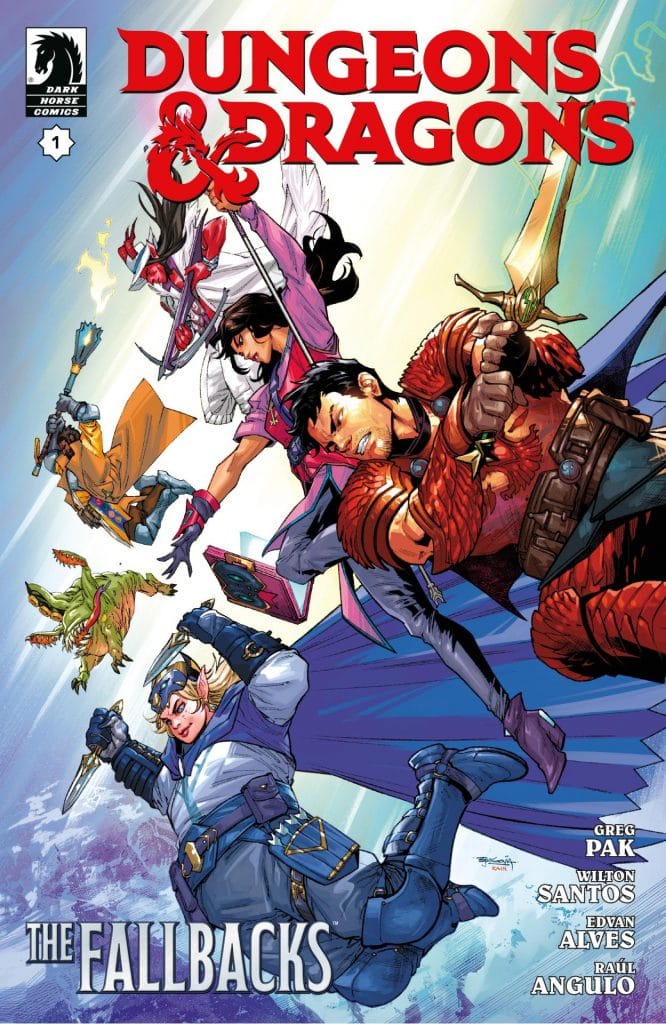
“Dungeons & Dragons: The Fallbacks” takes the characters from Jaleigh Johnson’s D&D novels and brings them into the comics. While the characters aren’t new to the Forgotten Realms, the story is still an original, rather than an adaptation of Bound for Ruin or Dealing with Dragons (which are also good novels I’d highly recommend). It also doesn’t require any prior knowledge about the Fallbacks or their previous adventures, as writer Greg Pak introduces them to the readers through both captions and the natural flow of the story.
Right off the bat, we’re given a clear understanding of who these characters are. A quick action sequence shows us each of their skills in action, from Tess’s teleporting daggers to Cazrin’s magic, while showcasing their personalities at the same time.
For instance, when we’re introduced to Tess, we see how she’s kind and generous by offering to give some coins to a kobold beggar… but also that the party is flat broke, which we can later see informs her actions when she chooses to get involved in any matter with a monetary reward. We get to learn more about other characters in a similar way, such as the fighter (Anson) trying to talk down his enemies before attacking, or through the banter the bard (Lark) exchanges with just about everyone.
In other words, the characters are absolutely brimming with personality in everything they do. Each one has a distinct voice that comes through in their dialogue, how they bounce off each other, and the choices they make throughout the story.
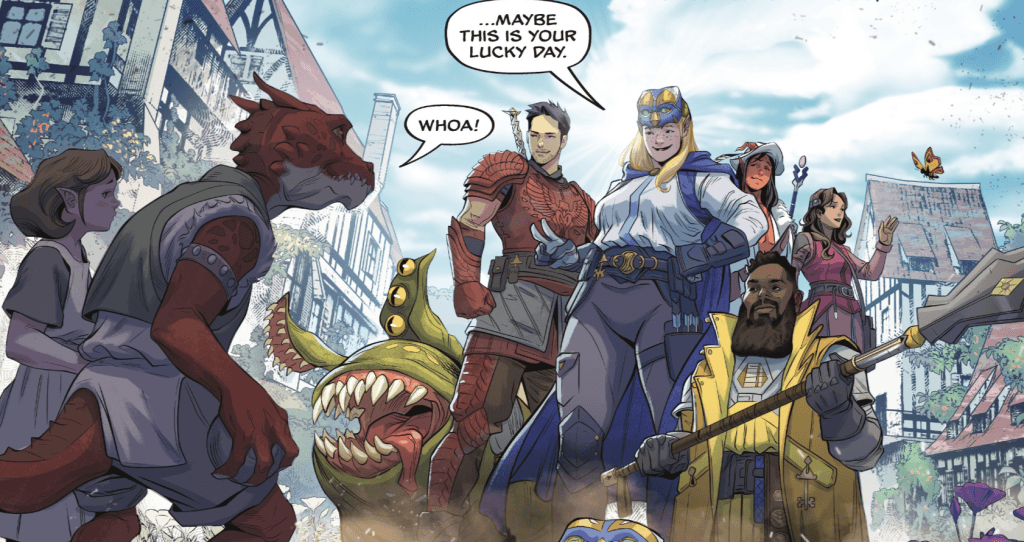
Now we get to the story itself. As this is the first issue, it mainly serves as an introduction and setup, but it still has the quintessential D&D elements that fans know and expect. Rival adventuring party? Check. A wide array of species and creatures from the game? Check. A dungeon with monsters and treasure? Check and check. It’s all there, and it fits into the narrative seamlessly, making the story feel like the start of a D&D campaign in the best of ways.
So we’ve got great characters, a strong supporting cast, and the start of a quest that kicks off with plenty of action and the promise of bigger adventures to come. What more could we ask for?
Now let’s talk about the art. Wilton Santos provides the penciling for this issue, with Edvan Alves doing the inking and Raúl Angulo on the colors. The art itself is excellent, with strong character designs, a great sense of panel composition, and the perfect balance of detail that makes the world feel alive.
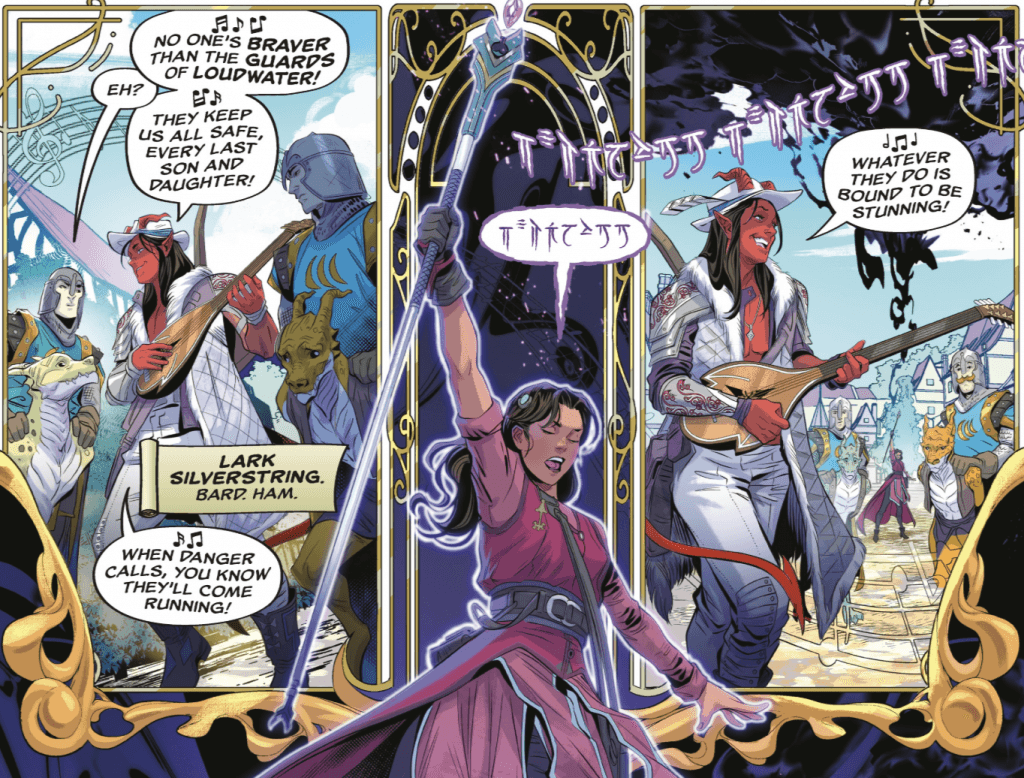
While the character designs themselves were established on the covers of the Fallbacks novels, Santos captures all their key elements in his own style and fills them with personality. Their expressions, body language, and even their framing in each panel showcase a great deal about who they are and how they’re feeling, even when they’re just standing in the background.
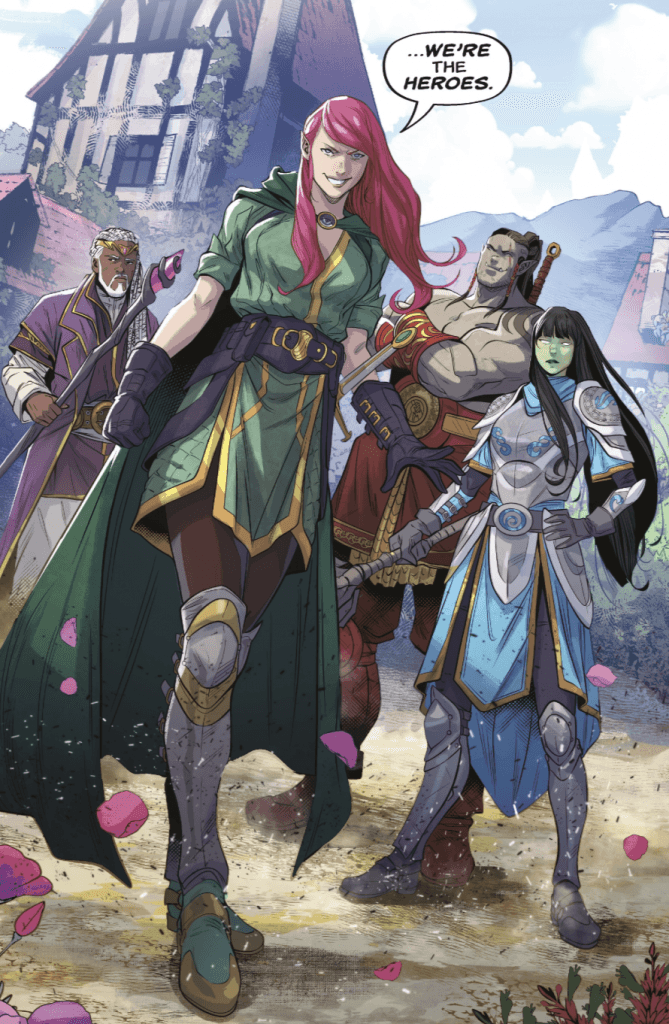
The same goes for the new characters and even the background characters. One look at the rival party and we can tell so much about them immediately, thanks to their designs and body language alone.
Also, there’s an important balance to strike with Uggie the otyugh to make a young garbage-eating monster both adorable and gross at the same time, and Santos nails it.
Each panel is filled with details on both the characters and backgrounds that make Faerun feel alive. The designs on the armor, the architecture of the buildings, and the characters hanging around the background of a tavern all add to the world, so they receive as much care and attention as the heroes. When we get to action scenes, the action is swift and fluid, capturing each key moment in the fight while controlling the pacing.
Santos often connects his panels by having details from one extend beyond the panel’s edge and into the next, or overlapping one with the one connecting to it. This subtle trick helps control the pacing, drawing our eyes from one scene to the next naturally. It’s particularly useful in the fight scenes, as it takes readers on a journey through the action.
All the while, Raúl Angulo’s color work brings each page to vivid life, helping the characters pop off the panel and adding a vibrancy to the world. Angulo’s color work is bright and clean, making it easy on the eyes and a fine match for Santos’s illustrations. Each character has a distinct color theme, like Lark’s white outfit over his red skin or Baldric’s gold coat, but they share enough elements that they feel connected, like a proper party should.
Angulo also knows when to shift the color to change the scene or accentuate action. The natural shades of sky blues and light brown streets give way to the yellow illumination of a tavern, which is replaced in turn by the darker blues and grays of the night sky and road. Sickly green shades let us know when evil undead approach, creating an unnatural atmosphere that controls the mood, and action scenes are occasionally highlighted with bright backgrounds of gold or red to bring out a key moment.
Good color work can do so much to control the atmosphere of the scene and impact of each moment, and Angulo’s colors do just that.
The worlds of Dungeons & Dragons contain limitless possibilities for adventures, characters, and stories for readers to enjoy. We’ve seen this through unforgettable stories like R.A. Salvatore’s Drizzt novels (and their comic book adaptations), Jim Zub’s comics following Minsc and his friends, and now, The Fallbacks. The comic feels like an actual D&D campaign, filled with fun banter, likable characters, and the start of a great adventure, with excellent artwork bringing each moment to life.
If you’re a fan of The Fallbacks novels, rest assured, the characters are in good hands. And whether you’re new to the world of Dungeons & Dragons or a longtime adventurer (or Forever DM) looking for a new story in the Realms, you’ll find it here.
The post Comic of the Week: “Dungeons & Dragons: The Fallbacks” #1 appeared first on G33K-HQ.
]]>The post Comic of the Week: “Jeff the Land Shark” #1 appeared first on G33K-HQ.
]]>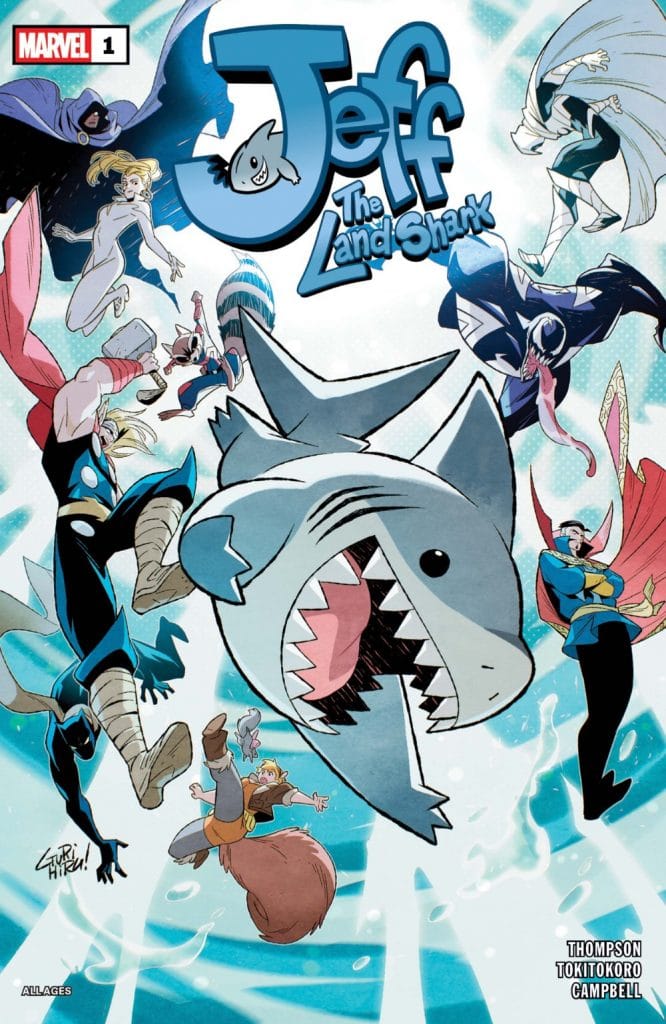
“Jeff the Land Shark” is written by Kelly Thompson, who first blessed the pages of Marvel Comics with everyone’s favorite land shark. It’s illustrated by Tokitokoro, with colors by Jim Campbell, and its main cover is drawn by Gurihiru (with several alternate covers from different artists available).
So, what exactly is the plot of “Jeff the Land Shark?” While digital comics like “It’s Jeff” give us snapshots of Jeff’s life as he travels around the Marvel Universe, having fun and maybe getting into trouble, “Jeff the Land Shark” takes that idea and turns one of his escapades into a full story. In this case, it begins with Jeff sneaking into Dr. Strange’s Sanctum Sanctorum, and the plot is driven by the consequences that follow.
After Jeff’s mischief makes him the target of a shadow demon, he’s got to chase down the fiend to recover his shadow before it’s too late. So it’s pretty low-stakes as far as comic stories go, but still a personal stake for Jeff, and it gives readers a reason to follow him as he chases his stolen shadow across the Marvel Universe.
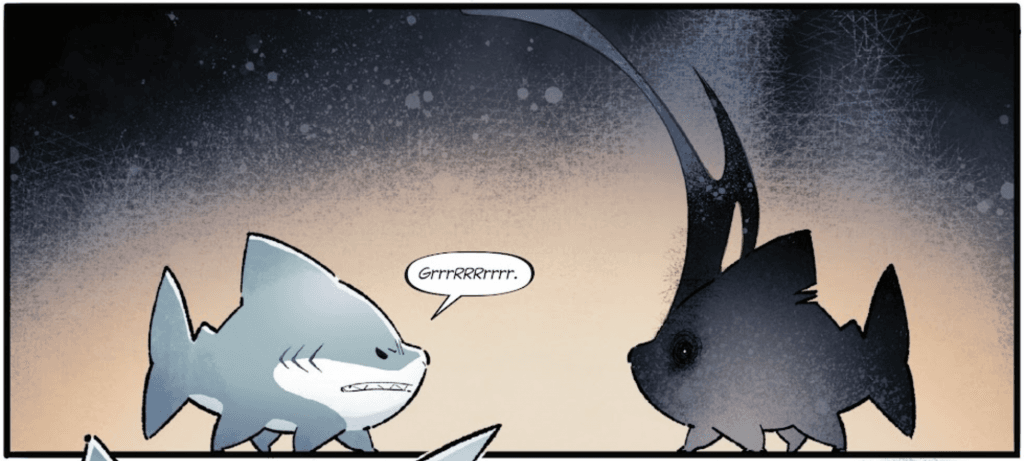
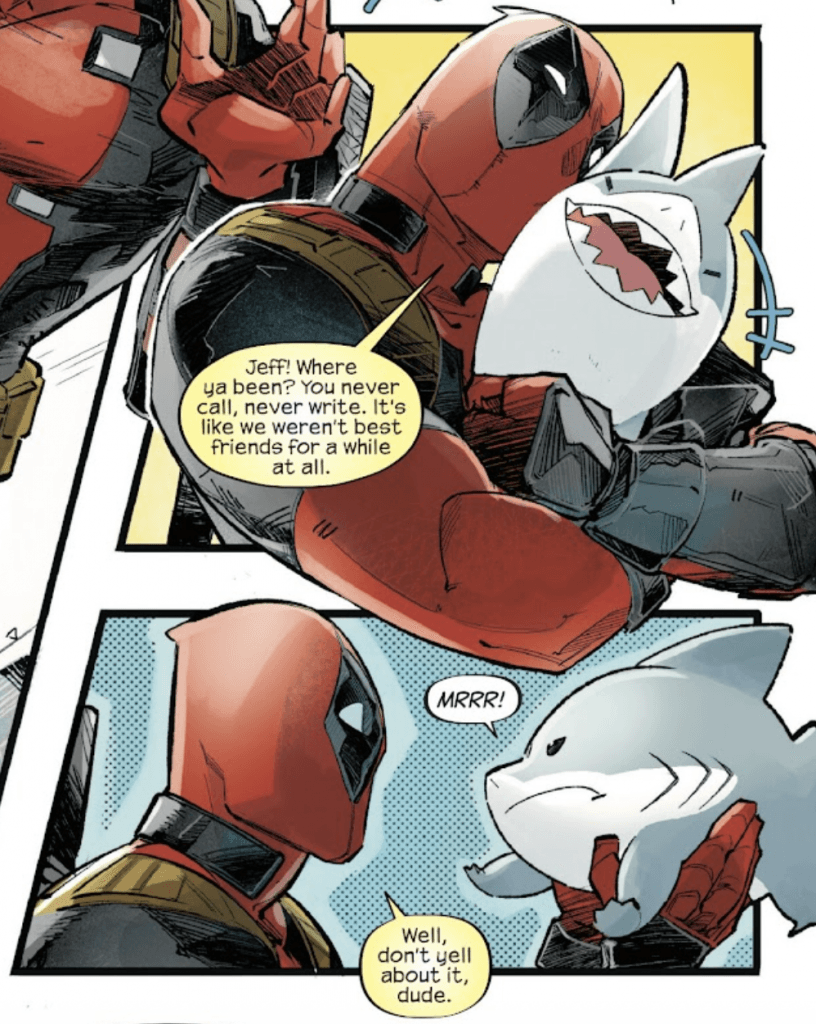
This comic also differentiates itself from “It’s Jeff” by giving characters dialogue (outside of Jeff, of course, who continues to communicate in “mrrrs,” “grrrs,” and “pffts”), rather than relying solely on visual storytelling. This allows writer Kelly Thompson to provide snarky commentary and a bit of exposition from characters like Anton and Aleister (two ghostly snakes that inhabit the Sanctum Sanctorum), as well as plenty of chatter from Deadpool. This keeps the comic’s atmosphere light and helps the story flow while giving Jeff other characters to bounce off of.
Of course, that’s not to say the visuals take a backseat, as most of Jeff’s adventure is shown through the artwork. As a non-speaking character, Jeff’s expressions and body language are essential for portraying his thoughts and personality.
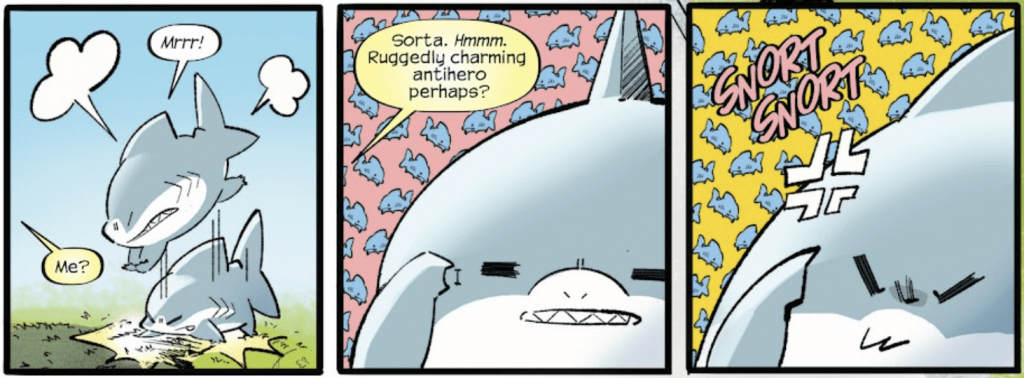
Artist Tokitokoro does an excellent job of setting the atmosphere of the comic and bringing Jeff’s personality out through the artwork. The character design leans more toward the adorable aspects of Jeff, making him more round and with a bit of an anime style to his expressions, which makes it all the more enjoyable. Tokitoro’s style leans to the cartoonish side, which works perfectly for the character and comic, and still captures the human character designs nicely.
Additionally, Tokitokoro’s artwork makes full use of panel sizing and spacing to control the flow of the comic. The panels are positioned and adjusted to move with the action on the page, like when a bouncing basket is captured in motion by tilting the panels it flies through, or a tilting table flips from one panel to another. While this can make the scenes hectic (and therefore a little harder to follow) at first glance, the way they contribute to the storytelling becomes clear and impactful when viewing each page as a whole.
Jim Campbell’s colors complement Tokitokoro’s artwork wonderfully, adding cheery bright colors to the already cartoon-like art. There’s just enough variety in the lighting and shadows to add volume to the characters, while maintaining the light shades and bright colors throughout the issue. It keeps the atmosphere light and joyful, while making every page visually engaging, especially when we get little colorful alterations to the backgrounds.
Campbell’s color work also brings out the shadows further, letting the grey and black contrast with the overall lightness of the setting without compromising the tone.
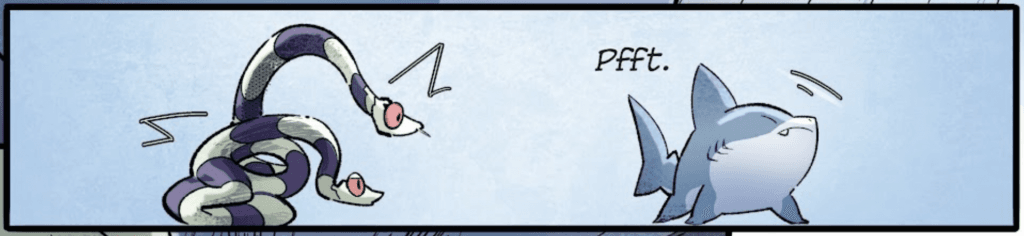
Whether you’ve been a fan of Jeff the Land Shark since he first appeared in “West Coast Avengers” or a new fan who uses him as your Marvel Rivals main, “Jeff the Land Shark” #1 is an absolute delight. Kelly Thompson is in top form, bringing us all the mischief and mayhem we’ve come to expect from Jeff in a fun-to-follow story, while Tokitokoro’s artwork and Jim Campbell’s colors bring it to life delightfully. The visual and narrative storytelling are top-notch, and it’s a purely fun comic to read.
If you like entertaining, lighthearted comics with clever dialogue, delightful visuals, and a fun cast, you’ll love “Jeff the Land Shark.” And if you don’t… then I’m sorry someone hurt you so badly.
The post Comic of the Week: “Jeff the Land Shark” #1 appeared first on G33K-HQ.
]]>The post Comic of the Week: “The Ultimates” #11 appeared first on G33K-HQ.
]]>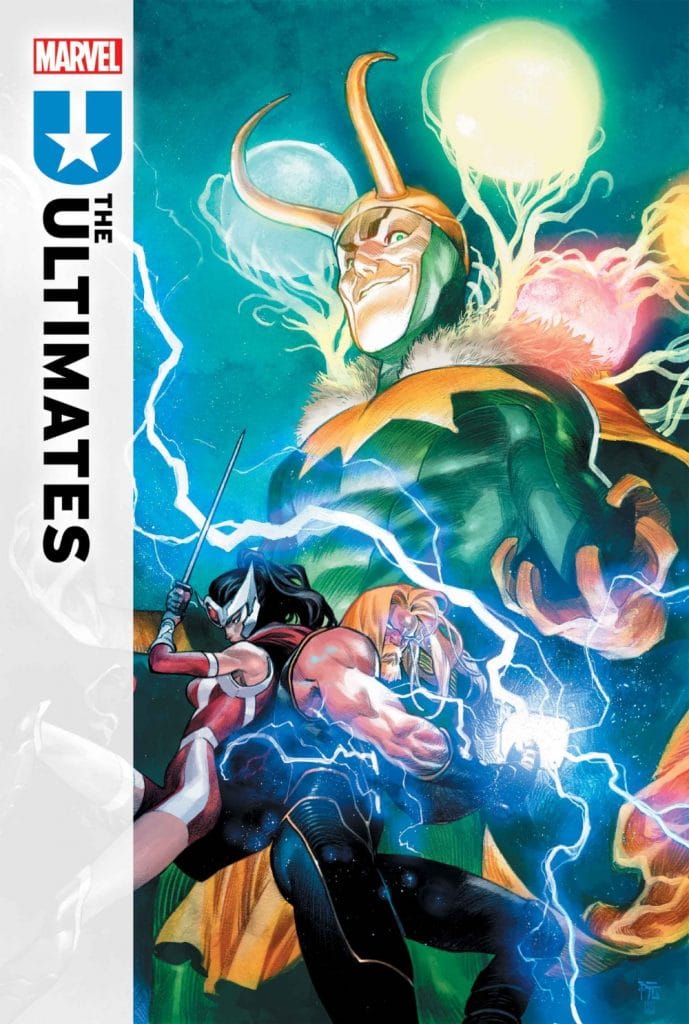
“The Ultimates” #11 is written by Deniz Camp, illustrated by Juan Frigeri, and illustrated by Federico Blee. While the comic has primarily followed the events on Earth, as the Ultimates battle against both powerful foes and bad PR, this issue takes us to Asgard to follow Thor and Sif in their struggle against Loki.
What makes this issue really stand out is the way it’s presented. Instead of a series of connected panels, filled with banter and motion, it’s told as an epic poem, with each scene filling an entire page with one image to illustrate the narration.
The epic poem itself is very well written, flawlessly carrying the narrative while making great use of plenty of literary techniques. We have rhyming couplets, rhymes within lines, a little alliteration (alright, a lot of alliteration, and admittedly above adequate at that), and so forth, which make the narration a joy.
The poem tells the story of Thor and Sif as they travel across the realms, seeing how Loki has chained and warped those living in it, how they gather allies, and their counterattack. But what really makes the story impactful are the messages therein.
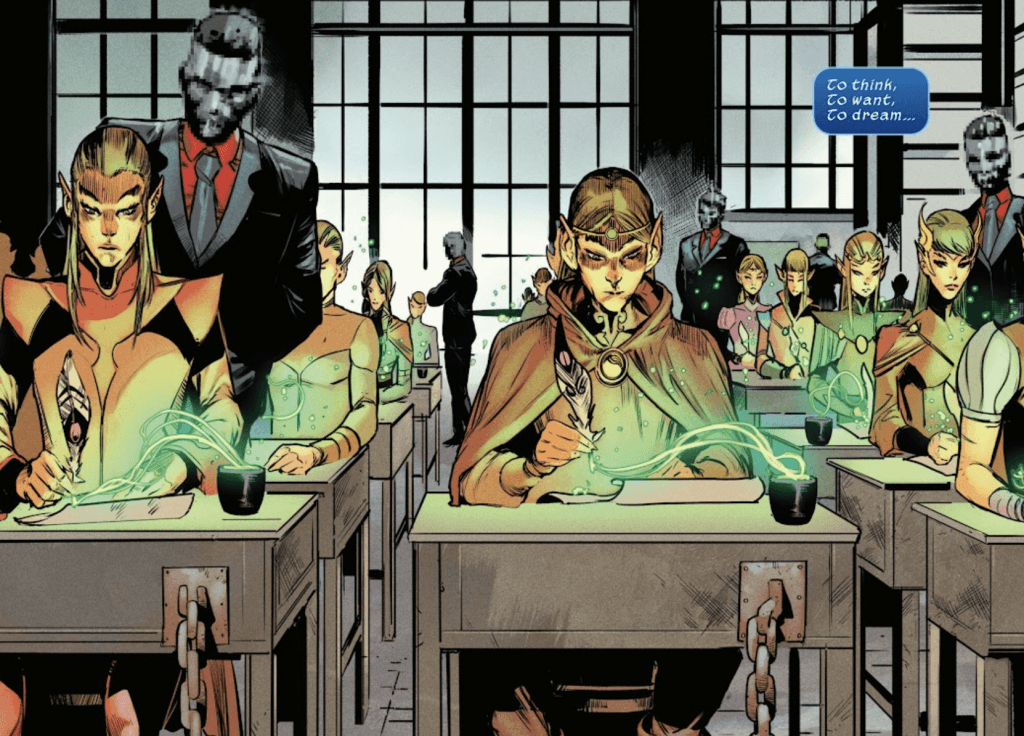
The dwarves of Nidavellir were turned from craftsmen to factory workers on an assembly line. The elves of Alfheim can no longer create art, but instead push out “content.” And the Vanir of Vanaheim stay neutral, choosing safety over doing the right thing. Loki and his followers use any opposition as an excuse to double down on the oppression.
I think we can all see the metaphors here, and they are wonderfully done, using the fallen realms as a mirror to our world. The message is equally clear, spelled out in large letters:
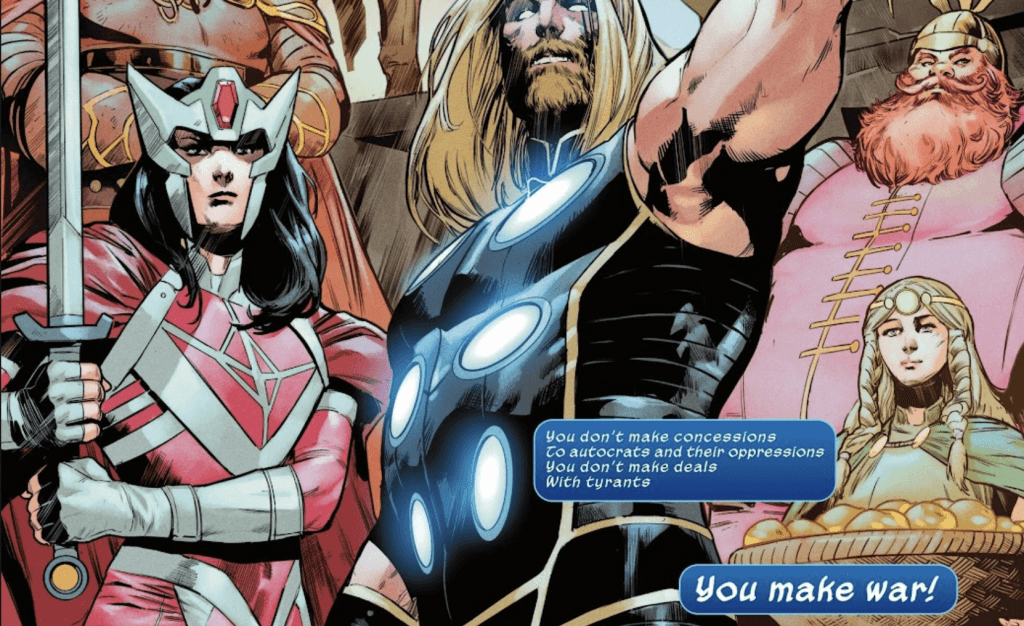
It’s a message that bears repeating these days, which makes their rise and revolution all the more impactful.
“The Ultimates” features artwork by Juan Frigeri and colors by Federico Blee. Frigeri’s artwork is just as epic as the narrative, emphasizing the characters’ heroic profiles and bringing the many inhabitants of the nine realms to life in excellent detail.
Each page is packed with detail that adds depth to the worlds and Loki’s rule over them. In Nidavellir, we see the massive factory the dwarves are forced to work away in. The emaciated, aged gods of Asgard create a horrifying image, contrasted immediately by skeletons feasting in their halls. The Vanir are a great blend of humanoid and nature, feeling truly mythical.
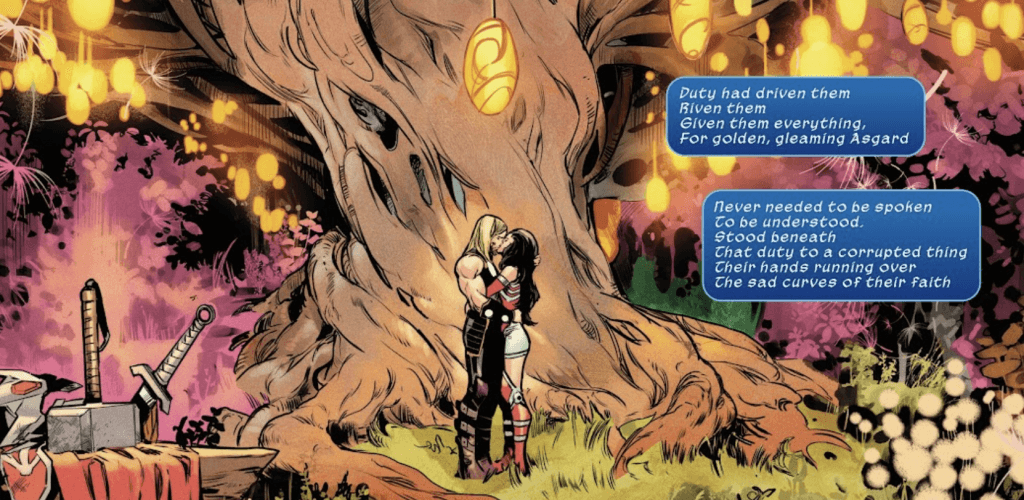
Then, of course, the action scenes are packed full of motion, even if they just take a single page. Thor’s battle against the frost giants of Jotunheim captures a perfect snapshot of the conflict, and the page where we see the assembled forces rise against Loki is, well, inspiring.
Blee’s colors bring each scene to life, controlling the lighting, atmosphere, and even the temperature with the tones and shading used. There are different colors dominating each realm, like the shades of black trapping the golden elves of Alfheim and the glow of their magic or the orange flames of Muspelheim.
Even if you haven’t been following the Ultimate Marvel universe (and frankly, you should), “The Ultimates” #11 is an issue well worth reading. Deniz Camp’s story and poetic narration carries readers across the story wonderfully, while Frigeri’s illustrations and Blee’s colors bring each scene to life, page by page.
The Ultimate Marvel universe has never been better or more exciting, and “The Ultimates” is the perfect gateway into this new world. This is an issue that’s not to be missed.
The post Comic of the Week: “The Ultimates” #11 appeared first on G33K-HQ.
]]>The post Comic of the Week: “Absolute Wonder Woman” #5 appeared first on G33K-HQ.
]]>
DC’s “Absolute” line of comics is a relatively new endeavor, introduced as part of the “DC All In” initiative. These comics give us new takes on classic DC superheroes, where familiar characters have been changed in one major way. We have a Batman without the wealth, a Superman who grew up on Krypton, and of course, a Wonder Woman who wasn’t raised in paradise, but rather in the underworld.
Yes, the Wonder Woman we meet in “Absolute Wonder Woman” is a fair bit different in many ways. She rides a skeletal pegasus, wields a massive sword (picture the Buster Sword from “Final Fantasy 7” and that’ll do it), not to mention her awesome tattoos. Yet at the same time, this is still very much the Diana readers know — her caring heart that shows compassion even for her enemies, her steadfast determination to protect people, and all those elements that make Wonder Woman the enduring character she is still remain. This is a Wonder Woman who can and will sacrifice her arm to help a friend without hesitation, and growing up in hell only made her more sympathetic to the monsters that lurk there.
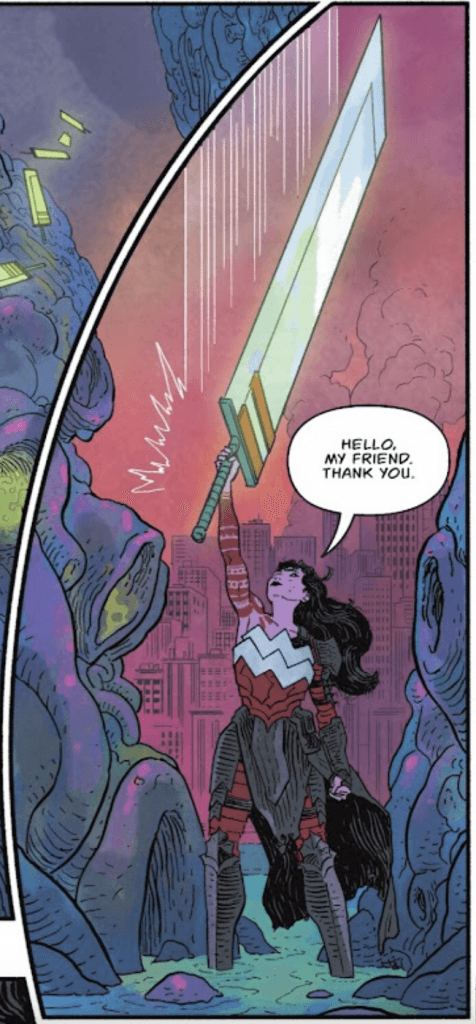
In short, writer Kelly Thompson has an excellent grasp of the character, and presents us with a Diana that’s both unique and familiar at the same time.
This issue picks up as we near the end of Wonder Woman’s first big battle. Her enemy? A gargantuan monster called the Tetracide, which, as the name suggests, brings mass death. While issue #4 ended with Diana dealing a devastating blow to Tetracide, it’s a big enough threat that she still needs to use a last resort to stand a chance of defeating it.
However, this issue’s story spends some time focusing away from the fight and instead looking at the last resort itself. While the “classic” Wonder Woman has a lasso that compels people to speak the truth, what kind of lasso would Circe (best known for turning men into pigs) equip her with? This turns into a good character moment for both Diana and Circe, as it explores their relationship as adoptive mother and daughter, the lengths Circe will go to in order to protect Diana, and Diana’s own stomach for cruelty.
Without spoilers, the choice Diana makes is one that is very much true to Wonder Woman’s core traits and values. As an added bonus, it ties into a well-known figure from Greek mythology and the cruelty of her fate.
So story-wise, it’s a solid end to a great introduction to the Absolute version of Wonder Woman, Thompson’s writing is top-notch, and she shows that even a Diana raised in hell still has her indomitable heart and spirit.
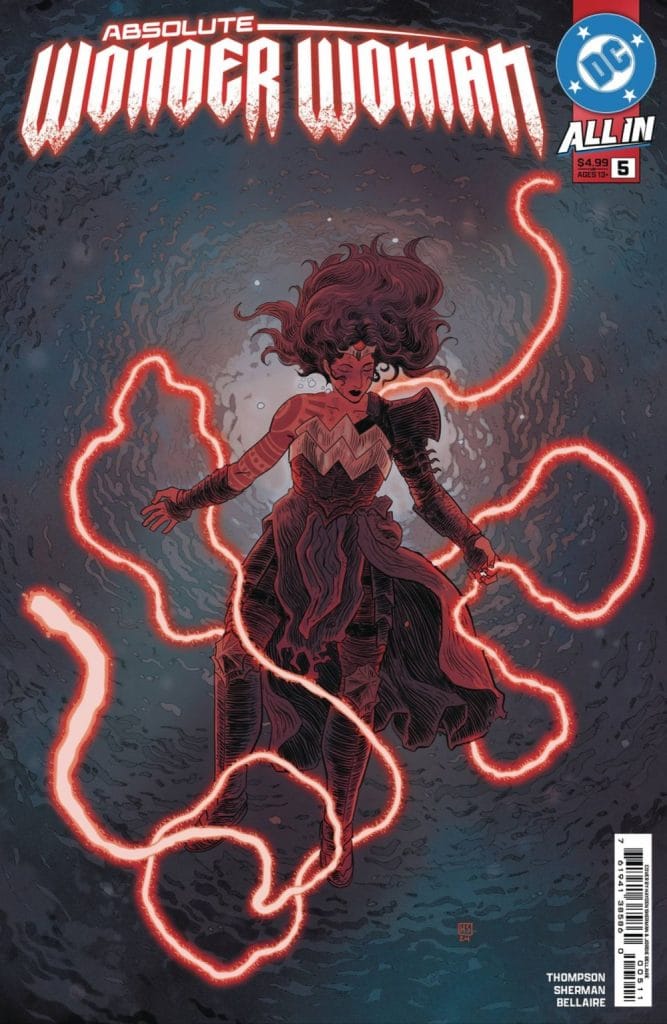
On to the artwork, we have Hayden Sherman providing the illustrations and Jordie Bellaire on colors. Sherman’s artwork captures a style that feels like illustrations from a story book or other traditional mediums, with curved shapes and wavy lines adding form and detail, but with a more flat feel to the designs that doesn’t rely heavily on shadows or volume to add depth to the imagery. Instead, it gives the comic a feel that’s less modern comic book and more classical mythology, which is appropriate for the character.
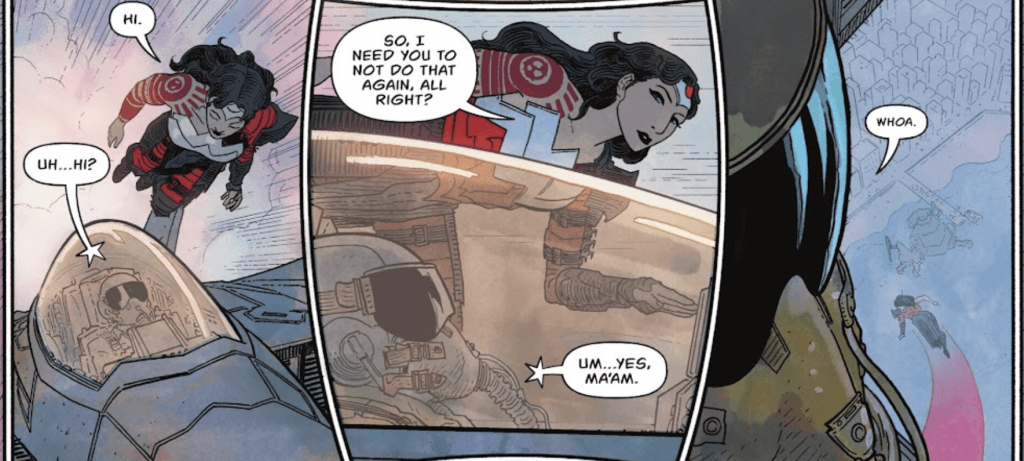
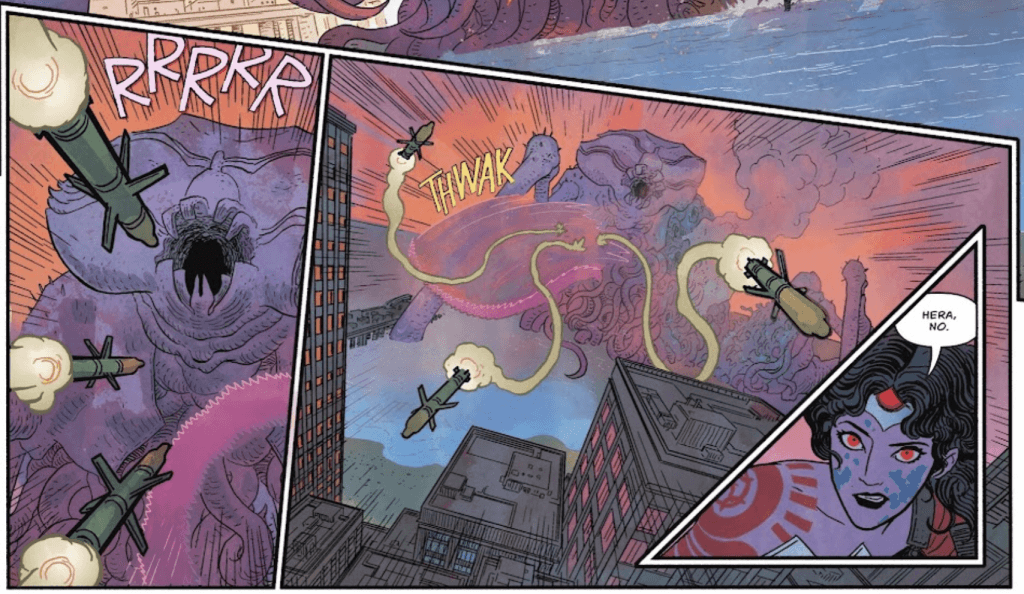
Sherman’s artwork really shines with the designs for monsters and other inhuman characters. The Tetracide, for instance, is a truly terrifying, otherworldly behemoth, with massive spindly limbs and writhing tentacles emerging from its body. Other monstrous forms we see are covered in detail, like Medusa’s writhing scales or the skeletal form of Wonder Woman’s pegasus. Diana’s meeting with a goddess gives us a glowing deity unlike traditional interpretations of the Greek gods, but still stunning and overflowing with power.
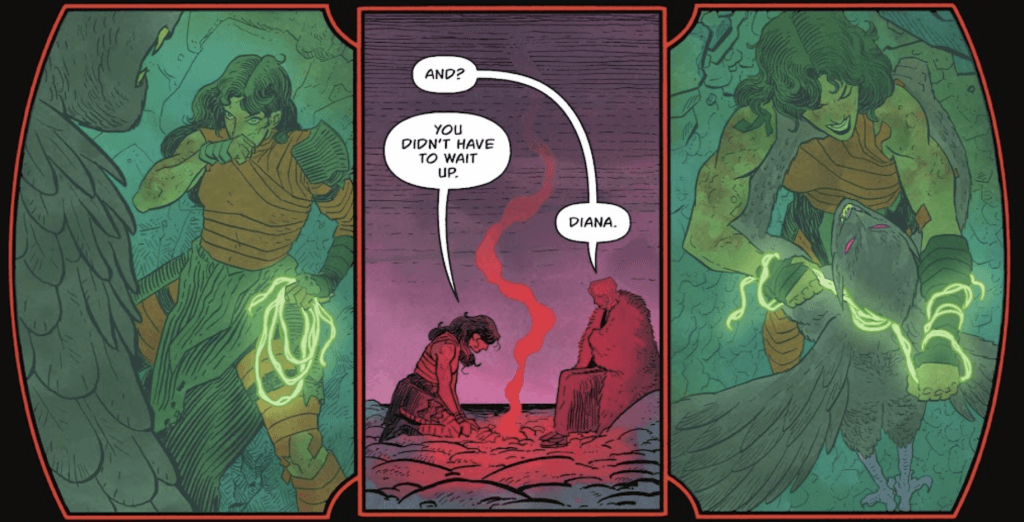
Another aspect that really stands out is the panel designs and layout. Rather than rely on traditional rectangular panels, Sherman relies primarily on unorthodox designs, with semicircles, curves, and triangular or oblong shapes throughout. They create a great frame for the story without interrupting the flow, making the pages feel more connected or mirroring themselves while allowing each moment to stand out either on its own or as part of a series of connected panels within a larger design.
If I had to critique one thing about the art, it would be the characters’ faces, which can often feel flattened or inconsistent. There’s little to no volume or shading to them, making them sometimes feel like flat shapes with eyes, a lengthy nose, and a mouth placed on. However, I have to stress that, while this is a point that stood out to me, it did not detract from the overall quality of the art; one stylistic choice that’s not my preference does not make the artwork bad.
Jordie Bellaire’s color work is well-suited for Sherman’s illustrations, adding solid shades to the designs but often using a watercolor-like effect that adds shading and enhances the mythological or storybook stylings of the illustrations. The skies and backgrounds carry shades of red, gray, or green, controlling the atmosphere and making the characters in the foreground stand out all the more. There’s a darkness to the colors, but it contrasts well with the sources of light, making them all the more illuminated.
The color work is most striking when there’s a glowing effect, especially from Wonder Woman’s lasso, which casts a green glow across the panel and draws the eye to its source. We get similar effects with Diana and Circe around a red fire, or the light of a goddess illuminating the panels in a blinding, pure white, which contrasts the pitch-black shadows that create her face.
So while the artwork is certainly different from what you’ll typically see in a modern comic book, that’s a point in its favor. “Absolute Wonder Woman” stands out with a new take on the character in every way, and the artwork matches that nicely.
So far, each of DC’s “Absolute” comics have been engaging and exciting new takes on classic characters, and “Absolute Wonder Woman” stands among them as a must-read for longtime and new fans of the character. It leans into the mythological elements of Wonder Woman’s history and uses them to great effect, with artwork that captures the atmosphere and top-tier writing.
The post Comic of the Week: “Absolute Wonder Woman” #5 appeared first on G33K-HQ.
]]>